

In the world of digital transformation, one of the most critical questions a business faces is whether to migrate its on-premise database to the cloud. It’s no longer a matter of if, but when and how. A successful cloud migration can unlock unprecedented scalability, cost savings, and operational agility. However, a poorly planned move can lead to downtime, data loss, and security vulnerabilities.
This guide will walk you through the strategic considerations to help you determine if your business is ready and how to approach the migration process effectively.

Why Migrate to the Cloud? The Core Business Benefits
Moving your database to a cloud platform like AWS, Azure, or Google Cloud offers compelling advantages:
- Scalability and Flexibility: Cloud databases can scale up or down on demand. Need more processing power during a peak sales season? You can get it in minutes, not weeks. This elasticity ensures you only pay for what you use.
- Cost Efficiency: Migrating to the cloud eliminates the need for massive upfront investments in hardware. You replace capital expenditure (CapEx) with a predictable operational expenditure (OpEx) model, freeing up capital for other core business initiatives.
- Enhanced Security and Compliance: Leading cloud providers invest billions in security. They offer robust security features, automated patching, and compliance certifications (like GDPR and HIPAA) that are often more advanced than what a typical in-house team can manage. Our Data Migration & Protection services are built around these best practices.
- Improved Accessibility and Collaboration: Cloud databases can be accessed securely from anywhere, empowering remote teams and enabling seamless collaboration. This data accessibility is crucial for modern BI tools, a specialty of our partners at Powered by Power BI.
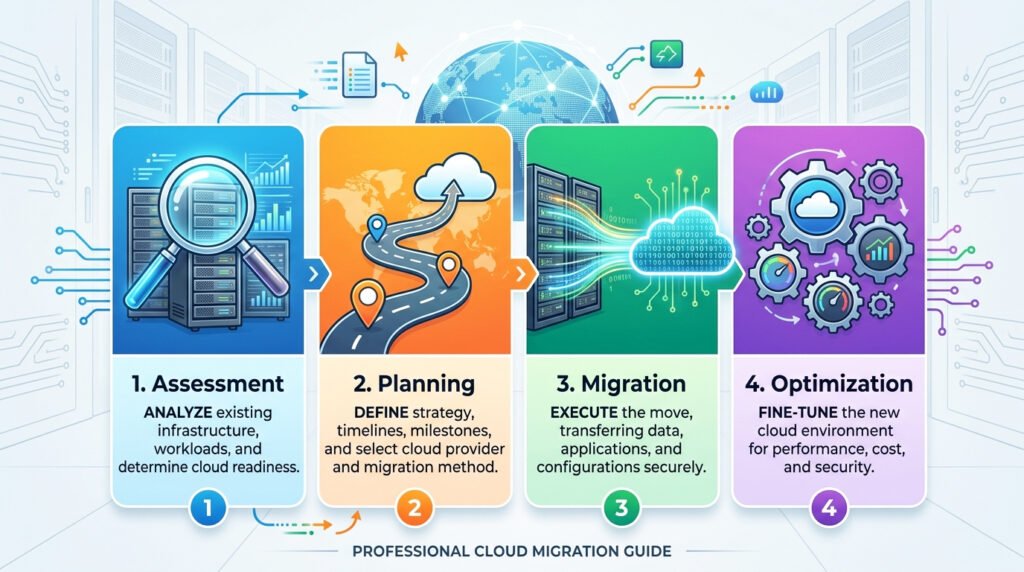
A Phased Approach to Successful Cloud Migration
A successful migration is a well-planned one. Our Database Consulting & Architecture experts recommend the following phased approach:
- Phase 1: Assessment and Discovery: We start by analyzing your current on-premise environment. What are your performance baselines? What are your application dependencies? This phase is about understanding what you have before you plan the move.
- Phase 2: Strategic Planning: Based on the assessment, we choose the right cloud provider and migration strategy (e.g., Rehost, Replatform, Refactor). We create a detailed project roadmap, timeline, and risk mitigation plan.
- Phase 3: Migration and Testing: This is the execution phase. The data is securely migrated to the cloud environment. Rigorous testing is then conducted to ensure data integrity, application functionality, and performance meet or exceed the original benchmarks. For complex applications, our partners at Power Soft can assist in refactoring the code to be cloud-native.
- Phase 4: Optimization and Validation: Post-migration, we fine-tune the new cloud database for optimal performance and cost-efficiency. We validate that all systems are running smoothly before the final cutover.
Making the move to the cloud is a strategic decision that can future-proof your business. With the right partner and a well-defined plan, you can ensure a seamless transition that unlocks the full potential of your data.
Ready to explore your cloud migration options? Contact us for a personalized consultation with our cloud database experts.